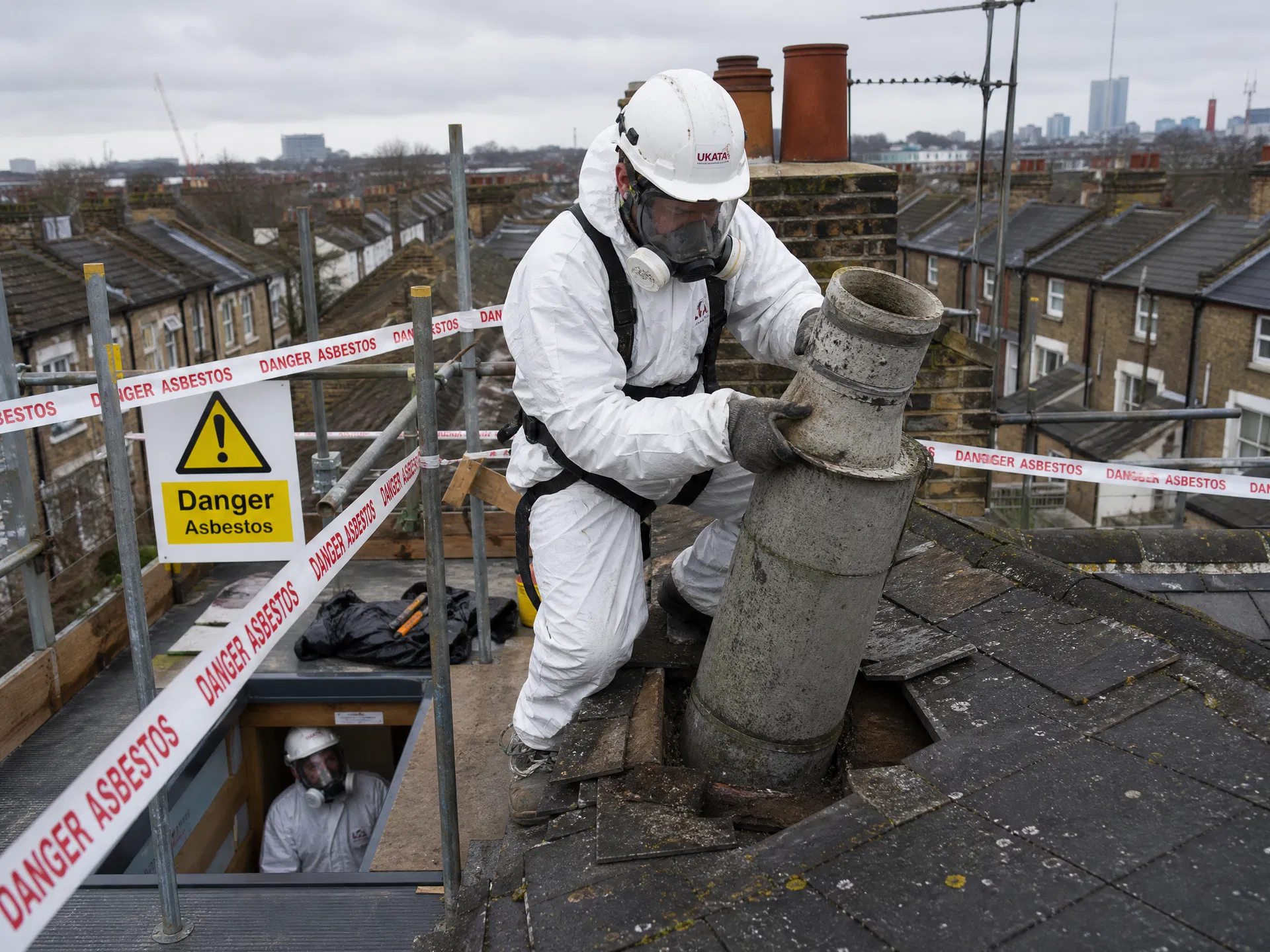
Asbestos-cement flue pipes from old gas fires, back boilers, and warm-air heaters should be removed intact, section by section rather than broken up, with the roof made good where the flue passed through. The pipe is brittle, and snapping it inside a chimney breast or at the roofline scatters fibres and fragments. Because almost every flue runs from a gas appliance, the appliance must first be disconnected by a Gas Safe registered engineer, and then we remove the flue.
Asbestos cement was widely used for domestic flue pipes from the 1950s to the 1980s, serving gas fires, back boilers behind the fire, warm-air heating units, and some solid-fuel appliances. They run up through chimney breasts, ceiling voids, and out through the roof, so they are often only found when an old heating system is being taken out. Flue removal is non-licensed work, which means we carry it out in-house.
What this service covers
- Asbestos-cement flue pipes from gas fires and back boilers
- Flues from warm-air heating units and some solid-fuel appliances
- Internal runs through chimney breasts and ceiling voids, and the section through the roof
- Making good the roof where the flue penetrated
- Double-wrapping and disposal at a licensed site through a registered waste carrier
Asbestos-cement flues are non-licensed work, which we carry out in-house. Any sprayed flue insulation or lagging is a different, higher-risk material needing a licensed contractor — we confirm which you have at the survey.
How we remove a flue
Survey & check
We confirm the flue is asbestos cement, trace its run, and check the appliance has been, or will be, disconnected by a Gas Safe engineer. Written price, no call-out charge.
Access & protect
We set up safe access to the run and the roof, and seal and protect the rooms the flue passes through.
Remove top-down
Working from the roof down, we secure the weight, break each socket joint wet, and lift the flue out a section at a time, wrapping each one as it comes out. Never snapped in the chimney.
Wrap, dispose & make good
The flue is double-wrapped and removed to a licensed disposal site, and we make the roof good where it passed through.
Why homeowners choose Diamond for this
A flue is the part of an old heating system that gets forgotten. It runs out of sight through the chimney and the roof, and the risk is twofold: fibres if it is broken indoors, and a hole in your roof if it is removed without a plan to close it. Doing it properly means taking it out intact and leaving the roof weathertight.
- Accredited and insured. UKATA-trained operatives, UKAS-accredited sample analysis, and full public liability cover on every job.
- Removed intact, roof made good. We take the flue out in sections without breaking it up, including the roof section, and leave the roof weathertight rather than leaving you with a hole and another trade to find.
- Straight about the gas side. We do not disconnect gas appliances — that is for a Gas Safe registered engineer — and we will tell you exactly how the two jobs sequence so nothing is done out of order.
What affects the price
We price each flue from a free survey rather than a flat rate. The main factors:
Not all flue work is non-licensed
Asbestos-cement flue pipes are non-licensed work, which we carry out in-house. Some flues are wrapped or insulated with sprayed coating or lagging, which is a higher-risk material that legally requires a licensed contractor, along with most asbestos insulating board. We confirm which you have at the survey, and if it is licensable work we will point you to a contractor who is licensed for it. The gas appliance itself is always disconnected by a Gas Safe registered engineer. See our note on licensable work →
Flue removal, answered
Get a free survey for your flue
Tell us the appliance and roughly where the flue runs, and we will arrange a survey and a written quote for removal, disposal, and making the roof good. No call-out charge.