Asbestos Artex and textured coating removal
We remove asbestos textured coatings, the swirled and stippled Artex-style finishes, from ceilings and walls in homes across London. The coating is softened and taken off wet, never dry-sanded, and we leave the surface ready to re-skim or decorate. UKATA-trained, fully insured, free survey.
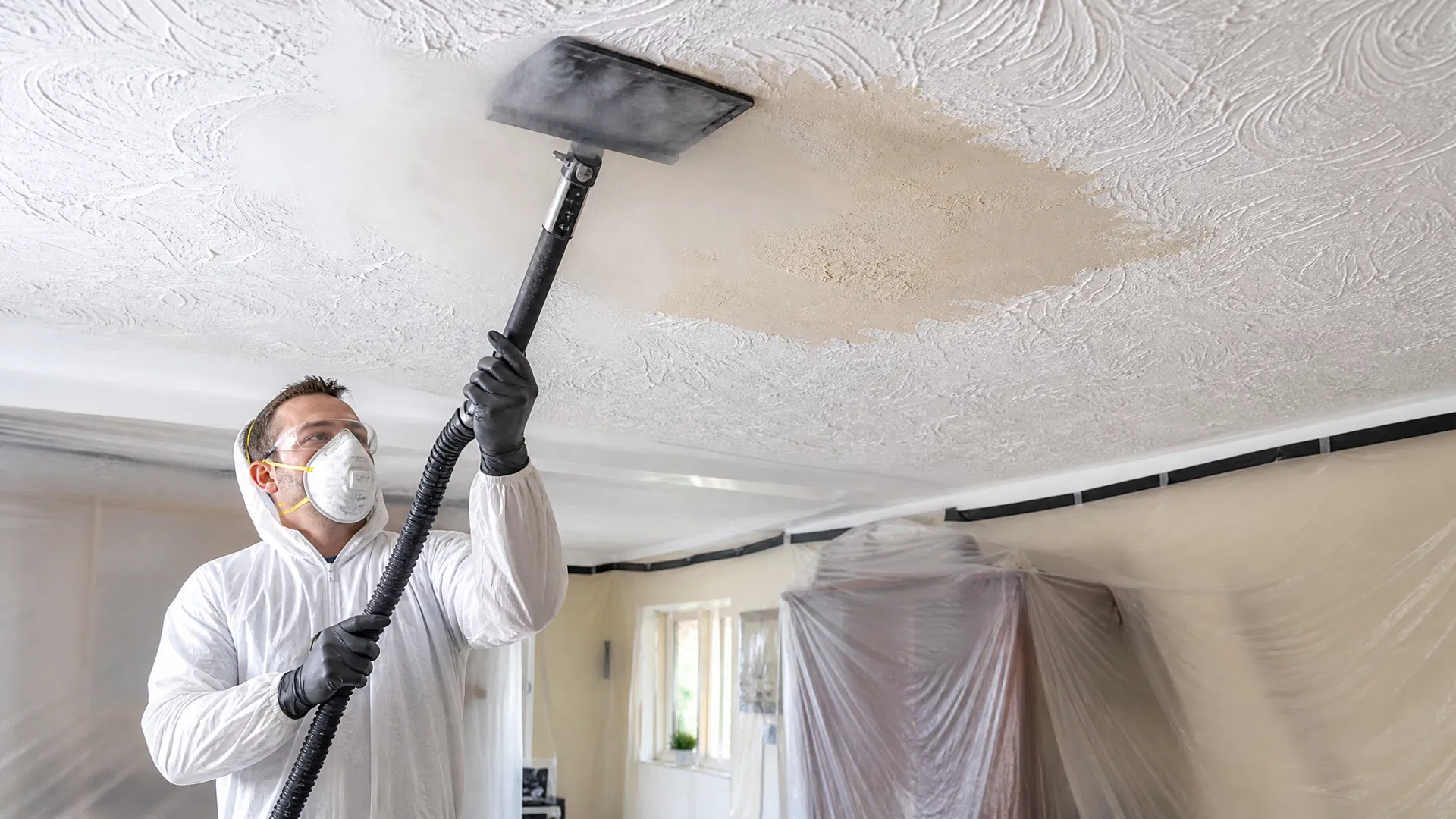 Photo: a textured Artex ceiling
Asbestos textured coatings such as Artex should be removed by softening them with steam or a gel stripper and taking them off wet, or by removing the whole board they sit on, never by dry-sanding or scraping them dry. The asbestos content of a textured coating is usually low, but sanding or dry-scraping it sends fibres straight into the room. Softening and removing it wet keeps the work clean.
Textured decorative coatings were used on ceilings and walls across the UK until asbestos was removed from them around the end of the 1990s, so a swirled or stippled finish applied before 2000 may contain a small amount of asbestos. It is non-licensed work, which means we carry it out in-house. This page covers what we remove, how we do it safely indoors, and the alternatives to full removal where they make sense.
What this service covers
- Textured coatings on ceilings, the most common location
- Textured coatings on walls, around stairwells, and on coving
- Removal of the coating, or removal of the whole board where that is cleaner
- Encapsulation or overboarding where full removal is not the best option
- Surfaces left ready to skim and decorate, with waste disposed of properly
Textured coatings are non-licensed work, which we carry out in-house. Asbestos insulating board ceilings and panels are a different material that needs a licensed contractor, so see the referral note below.
How we remove a textured coating safely
Survey & quote
We confirm the coating contains asbestos, advise whether to remove or encapsulate, and give you a clear written price. No call-out charge.
Seal the room
We seal off the room and protect the floor and the route in and out, so nothing spreads through the rest of your home.
Soften & remove wet
We soften the coating back to a wet state, by steam on hard substrates or a gel softener on plasterboard, and scrape it off clean. Never dry-sanded or scraped dry.
Wrap, dispose & make good
Waste is double-wrapped and removed to a licensed disposal site, and we leave the surface ready to skim and decorate.
Steam or gel: how we choose, and why never a sander
Hit a textured coating with a sander or a dry scraper and you are pulverising the binding matrix, shattering the material and releasing microscopic, highly respirable fibres straight into your breathing zone. It turns a low-risk, firmly bound product into an airborne hazard in seconds. Any dry friction makes dust, and in this work visible dust means you have already failed. So everything we do is about returning the coating to a wet, pliable state before it moves, and the method depends entirely on what the ceiling is made of.
The substrate decides the method. Get that wrong and you either bring the ceiling down or generate a mountain of waste.
Steam stripping uses wallpaper steamers to drive heat and moisture into the coating. It is fast, around 5 to 10 minutes a section, and excellent on coatings applied to concrete or hard plaster. On plasterboard it is unforgiving: leave the plate in one spot a minute too long and the paper face turns to mush and the ceiling loses its integrity. So for plasterboard or anything delicate we switch to a gel or poultice softener such as X-Tex, a thick water-based solvent painted on heavily that breaks the coating down slowly without evaporating. It needs 45 to 60 minutes, and on thick coatings we often leave it overnight. It introduces no destructive heat, which is why it is the right call on board, but it generates a lot of heavy, wet, sticky waste that pushes up the disposal volume and cost. We weigh that against the ceiling we are working on, every time.
Why homeowners choose Diamond for this
Artex is almost always overhead, in rooms you live in. The risk is the dust a careless removal puts into the air above your head, and the fact that it settles everywhere. That is entirely about method and containment, not how fast the ceiling comes down.
- Accredited and insured.
UKATA-trained operatives, UKAS-accredited sample analysis, and full public liability cover on every job.
- Clean overhead work.
We seal the room and protect the floor and your route through the house, so the rest of the home stays usable and clean.
- The right option, not just removal.
Sometimes encapsulating or overboarding is safer and cheaper than stripping. We tell you when, rather than selling you a strip-out you do not need.
If you have begun removing an Artex ceiling and realised it may contain asbestos, stop, leave the room, and do not sweep or vacuum the debris. Close the door and call us. We will make the area safe and finish it properly.
What affects the price
We price each job from a free survey rather than a flat rate. The main factors:
Not all asbestos is non-licensed work
Textured coatings are non-licensed work, which we carry out in-house. Some higher-risk materials, such as sprayed coatings, pipe lagging, and most asbestos insulating board, including AIB ceiling panels, legally require a licensed contractor. We do not carry out that work ourselves, but if your survey turns it up we will point you to a contractor who is licensed for it.
Artex removal, answered
Does my Artex actually contain asbestos?
Can I just skim or paint over it?
Do I have to leave home while you work?
Can you re-skim the ceiling afterwards?
Will steaming it damage my plasterboard ceiling?
What happens to the waste?
Get a free survey for your textured coating
Tell us the rooms and roughly the area, and we will arrange a survey and a written quote for removing or encapsulating the coating and leaving the surface ready. No call-out charge.