Asbestos soffit, gutter and downpipe removal and replacement
We remove asbestos-cement soffits, fascia boards, guttering, and downpipes from homes across London, and fit new UPVC in the same visit. The old material comes off the eaves whole, never broken at height, so nothing rains down on your garden. UKATA-trained, fully insured, free survey.
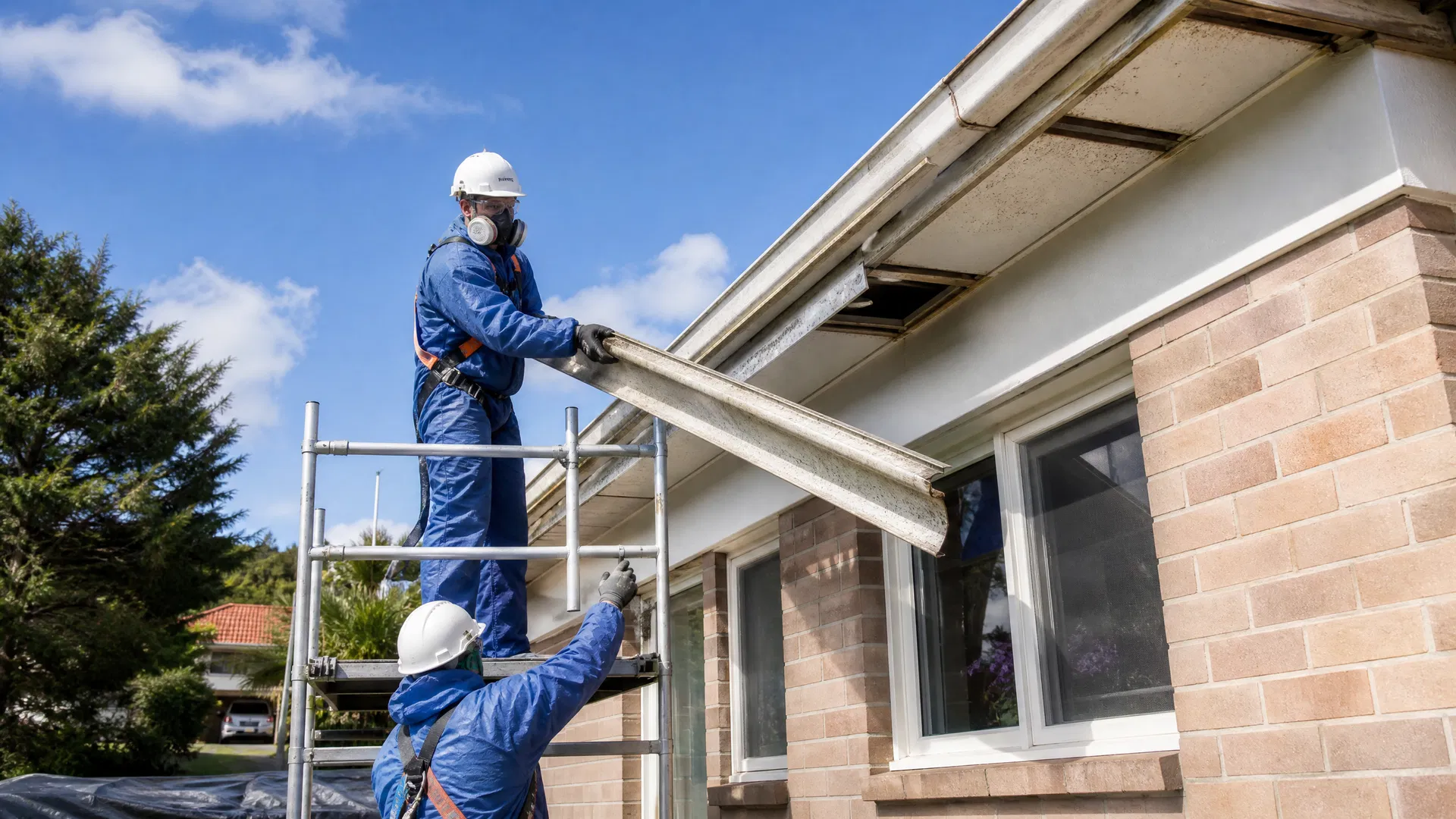 Photo: AC soffits and guttering at the eaves
Asbestos-cement soffits, fascias, gutters, and downpipes should be removed whole from the eaves, not broken down at height, then replaced with new UPVC. The material is brittle, and snapping a gutter run or a soffit board three or four metres up sends fibres and fragments down across the area below. Taking each length and board off intact keeps the work clean and the ground safe.
Asbestos cement was a common choice for rainwater goods and soffit boards on houses built or refurbished from the 1950s to the mid-1980s. It usually comes to light when a homeowner books new fascias and soffits and the installer refuses to touch the old asbestos ones, or during a re-roof. It is non-licensed work, which means we carry it out in-house. This page covers what we remove, how we work it safely at height, and how the new UPVC goes on in the same visit.
What this service covers
- Asbestos-cement soffit and fascia boards along the eaves
- Asbestos-cement guttering runs and joints
- Asbestos-cement downpipes and hoppers
- Double-wrapping and disposal at a licensed site through a registered waste carrier
- Supply and fit of new UPVC soffits, fascias, and guttering in the same visit
Asbestos-cement soffits and rainwater goods are non-licensed work, which we carry out in-house. Some soffit boards are asbestos insulating board rather than cement, which is a different material needing a licensed contractor, so see the note below.
How we strip and replace the eaves
Survey & identify
We confirm whether the soffit is asbestos cement or the higher-risk insulating board, assess access, and give you a written price for removal, disposal, and new UPVC. No call-out charge.
Access & protect
We set up safe access along the eaves and protect the ground and beds below before any board or gutter is disturbed.
Remove whole
We take the gutters, downpipes, and soffit boards off intact, lowering each length under control rather than dropping or snapping it.
Wrap, dispose & fit UPVC
The old material is double-wrapped and removed to a licensed disposal site, and new UPVC soffits, fascias, and guttering go on.
Cement or board? We settle it before a tool comes out
Most asbestos soffits are asbestos cement, which is non-licensed work we carry out ourselves. But some are asbestos insulating board, and the two look almost identical from the ground. The difference matters enormously. Cement is dense and binds its fibres tightly, typically 10 to 15% chrysotile. Insulating board is soft and porous, was made for fire protection, and can hold up to 40% asbestos, often the more hazardous brown and blue fibres that release far more easily. Board is a licensed job requiring a fully licensed contractor and a sealed enclosure, so we don't touch it.
So we check, every time, and the tells are consistent.
Cement is rock hard, so its fixings sit flat and proud, often with tiny star cracks where the brittle sheet fractured as the nail went home. The back face usually carries a dimpled, golf-ball pattern from the manufacturing press, and the cut edges are sharp and clean. Board behaves the opposite way: nails tend to sink into the soft surface, you will often see large spreader washers fitted to stop it pulling through in the wind, the edges look bruised and fibrous, and both faces are smooth. On an unpainted patch, usually where the soffit meets the brickwork, a little water tells the same story, beading on dense cement and soaking straight into board like a sponge. Even the sound differs: cement gives a sharp, slate-like note, board a dull, hollow thump like plasterboard.
Our golden rule is simple: if a soffit sounds dull, drinks water, or has sunken fixings, we treat it as insulating board, full stop. Work stops, we lock down any damaged edges to keep fibres in place, and we send a sample to a UKAS-accredited lab to confirm it before anyone goes near it again. On a soffit, guessing is the one thing you cannot afford to do.
Diamond Asbestos removal team
South-East London
Why homeowners choose Diamond for this
Soffits and gutters are at the top of the wall, over the parts of the garden people use. A careless removal does not just risk fibres, it drops broken fragments across patios, beds, and paths. Doing it cleanly is about access and control, and about not leaving the house open at the roofline between trades.
- Accredited and insured. UKATA-trained operatives, UKAS-accredited sample analysis, and full public liability cover on every job.
- Removal and new UPVC together. We strip the asbestos and fit the new fascias, soffits, and gutters in the same visit, so you do not need a separate installer who will not touch the old material.
- Proper disposal, with paperwork. Every length and board goes to a licensed disposal site through a registered carrier, and you get the documentation to prove it.
Roofer or installer refused to touch it? That is the right call on their part, and the common reason people call us. We remove the asbestos safely and hand you back a finished roofline in new UPVC, rather than a half-done job.
What affects the price
We price each job from a free survey rather than a flat rate. The main factors:
Run lengths
The metres of soffit, fascia, gutter, and downpipe to remove and replace.
Height & access
Bungalow versus two or three storeys, and whether towers or a MEWP are needed.
Condition
Sound material versus painted, fragile, or already-damaged boards and runs.
New UPVC spec
The replacement fascia, soffit, and gutter system and colour you choose.
Not all soffits are non-licensed work
Asbestos-cement soffits and rainwater goods are non-licensed work, which we carry out in-house. Some soffit boards are asbestos insulating board, which looks similar but is a higher-risk material that legally requires a licensed contractor, along with sprayed coatings and pipe lagging. We confirm which you have at the survey, and if it is board we will point you to a contractor who is licensed for it. See our note on licensable work →
Soffit and gutter removal, answered
How do I know if my soffits and gutters are asbestos?
Why won't my roofer or installer touch them?
Do you replace it all with UPVC?
Do you need scaffolding?
What happens to the waste?
Get a free survey for your soffits and gutters
Tell us the property and roughly the run lengths, and we will arrange a survey and a written quote for removal, disposal, and new UPVC. No call-out charge.