Asbestos cement sheeting and cladding removal
We remove asbestos-cement sheeting and wall cladding from industrial units, commercial premises, and outbuildings across London, then re-clad where you need it. Sheets come off whole under dust suppression, never broken on site. UKATA-trained, fully insured, free survey.
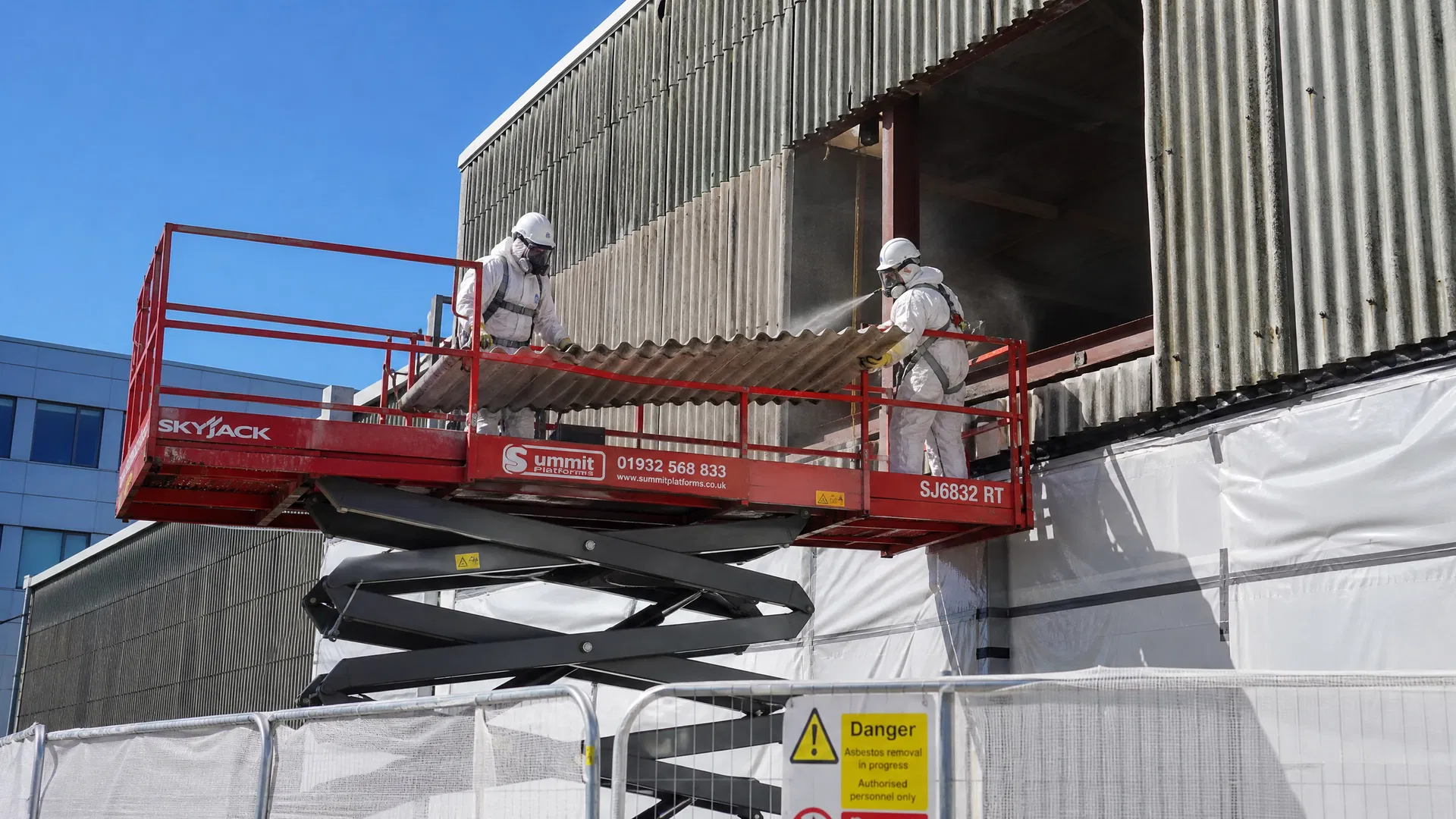
Asbestos cement sheeting and cladding should be removed by taking the sheets down whole, not by cutting or breaking them in place. The cement holds the fibres firmly while a sheet is sound, so the risk comes from damage: drilling, snapping, or dropping a sheet. Removing each panel intact, under dust suppression, keeps fibre release to a minimum, and it is how we strip every cement-clad elevation we work on across London.
Asbestos cement was used widely from the 1950s to the mid-1980s for roof sheeting and wall cladding on factories, warehouses, workshops, garages, and farm buildings, as well as flat sheets used as soffits and partition panels. It is a non-licensed material, which means we carry out this work in-house rather than referring it on. This page covers what we remove, how we do it safely, and how replacement cladding fits into the same job.
What this service covers
- Corrugated and flat asbestos-cement wall cladding on industrial and commercial units
- Cement roof sheeting on larger structures, workshops, and outbuildings
- Cement panel walls, partitions, and dividing sheets in garages and stores
- Double-wrapping and disposal at a licensed site through a registered waste carrier
- Supply and fit of replacement cladding, so the building is closed back up in one job
Cement sheeting is non-licensed asbestos work. Working asbestos-cement soffits and gutters? See our soffit and gutter removal page. Removing a garage roof? See asbestos garage roof removal.
How we strip a cement-clad elevation
Survey & quote
We confirm the material and its condition, assess access and working at height, and give you a written price for removal, disposal, and any re-clad.
Access & suppress
We bring in a wide-deck scissor lift wherever we can, protect the areas below, and apply dust-suppressant before any fixing is disturbed.
Remove fixings & lift whole
We release the hook bolts or drive screws and take each sheet down intact, lowering it under control rather than dropping it.
Wrap, dispose & re-clad
Sheets are double-wrapped, removed to a licensed disposal site, and new cladding is fitted where required.
Why we strip cladding from a scissor lift, not a scaffold
Scaffold is the default for most work at height, but on large-scale asbestos cladding it can create the very hazard you are trying to avoid. Picture a single corrugated sheet: three metres long, brittle, and weighing around 40 kilograms. On a fixed scaffold you have to unbolt that sail of a sheet and then thread it out through the poles, ledgers, and handrails to reach a hoist. The twisting and bending needed to work it through that matrix is exactly what snaps a cement sheet, and a snapped sheet is what releases fibres.
So we almost always work cladding from a wide-deck scissor lift instead. It gives us a completely clear face to work against.
We drive the lift flush to the elevation, detach the sheet, tilt it gently back onto the flat deck, and drive the whole machine down to the wrapping station at ground level. No threading through steelwork, no passing it hand to hand down a scaffold, no drop. The sheet stays intact from the wall to the polythene, which is the entire point. Where an elevation genuinely cannot be reached by a lift, we plan the access around keeping sheets whole rather than forcing them through a structure that will break them.
Why managers and owners choose Diamond
On a commercial elevation, the risk is not just the asbestos. It is dropping fibres onto a yard people are still using, or leaving a unit open to the weather. Both are avoidable with the right method and the right access.
- Accredited and insured.
UKATA-trained operatives, UKAS-accredited sample analysis, and full public liability cover on every job.
- Removal and re-clad together.
We strip the asbestos and close the building back up, so you brief one company and the unit is not left open between trades.
- Built around your operation.
We can phase the work around an occupied unit and respond 24 hours a day when cladding has been damaged.
Do not disturb it or clear up debris. Leave the area and call us. We run a 24-hour call-out across London and will make it safe.
What affects the price
We price each job from a free survey rather than a flat rate. The main factors:
Not all asbestos is non-licensed work
Cement sheeting and cladding are non-licensed work, which we carry out in-house. Some higher-risk materials, such as sprayed coatings, pipe lagging, and most asbestos insulating board, legally require a licensed contractor. We do not carry out that work ourselves, but if your survey turns it up we will point you to a contractor who is licensed for it. See our note on licensable work →
Cement cladding removal, answered
Is asbestos cement cladding dangerous if it is in good condition?
Do you work on commercial and industrial units?
Can you remove cladding while we stay operational?
Do you replace the cladding as well?
Will you scaffold the whole building?
What happens to the asbestos after removal?
Get a free survey for your cladding or sheeting
Tell us the building type and the area involved, and we will arrange a survey and a written quote for removal, disposal, and any re-clad. No call-out charge.